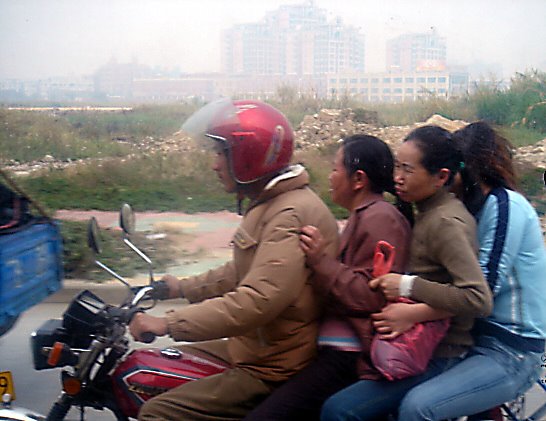
I have been in China now for just over a week. It began at DIA on February 18th while waiting for the plane to show up at the gate. I was amazed with the number of Chinese businessmen (12-15) at the airport waiting for the plane to San Francisco, before they would catch their connecting flights to Hong Kong, Shanghai, or Beijing. I am used to seeing these business men on the flight from San Francisco, but not at the origin in Denver. It made me believe that the Chinese outreach to sell their products directly to the largest market in the world is happening even faster. For the past decade or so, China has been the world’s shop in the back, but now Chinese companies are increasing their efforts to establish a brand and sell directly to the U.S. rather than thru their typical distribution channels.
I arrived into Hong Kong on Sunday evening and spent the next 18 hours in Hong Kong before taking the train into China. It was the first time I have taken the train into China and I was impressed with the convenience. I have taken the bus and ferry many times, but the train seemed to be the quickest. I went thru immigration at the Hong Kong train station and didn’t go thru Chinese immigration till I got off the train in Dongguan at Changping station. The whole trip took just over one hour and then I was only a 10 minute cab ride from the hotel in Huangjiang. It is definitely the fastest way to get to Dongguan from Hong Kong. I spent Tuesday visiting suppliers of one of our clients helping to do some follow up project management.
Tuesday evening I was in Shenzhen and had dinner with our new team members there, Rosa and Angela. It was Wednesday that would be the long and exciting day! We began the morning visiting a company quite close to my hotel. However, it was the old factory and they are in the process of moving, so our host was very rushed to show us the production before we jumped back in the minivan and left to visit the new factory about one hour away. Because the infrastructure still isn’t complete in many places in China, it is quite common to spend a lot of time in a car. After visiting the factory, the host took us for a quick lunch (which is not very common…usually lunches can last a long time) and then drove us to our next appointment. I was very impressed with the customer service of the first company that day; it was the 2nd company that made our late afternoon interesting.

The capabilities of the company were actually very impressive. It was a world class manufacturing center, and they were making so much money, they didn’t feel they needed to focus on customer service, particularly small customers like us. The challenge came when we left the meeting, they didn’t offer to arrange transportation for us. So, we left the company and began walking. I was joking with Rosa and Angela that we were taking “Bus #11” because our legs represented the number. We walked for about 30 minutes and got some general directions from two locals who pointed us in the direction of National Highway #107. However, they warned us that the road up ahead was bit dangerous, meaning there was a lot of thugs and thieves. Well, shortly after that a taxi came by and he was able to take us to the main highway. When we arrived at the highway, it was packed with traffic. Most of the traffic was large trucks carrying goods to the port, but there were also a few buses dispersed among them. Angela asked the local police which bus number would take us to Nanshan where we were staying. A few moments later, she waved down the bus and the three of us got onto a packed bus. It took us one hour to get to the checkpoint station in Shenzhen, Nantou where we got off the bus.
Then we encountered the next challenge. In the early days of Shenzhen’s development, this checkpoint controlled the workers that entered into the Shenzhen area. Workers were required to have their national ID card as well as a permit. Now the permit’s are no longer required, but the Chinese nationals are still required to show their ID if they are walking thru the checkpoint. Unfortunately, Angela had left her ID at home which was on the other side of the checkpoint. Thinking quickly, Rosa decided that I could walk thru first with her and then take her ID back to Angela. As long as Angela went thru a different line, there should be no problems. It was still a bit nerve-racking, but as a “Laowai” (foreigner), I could run back thru and pretend I had dropped something or was looking for something back on the other side…which is exactly what I did. I went back thru and passed Rosa’s ID to Angela and told her to not go into line #8 and that I would follow her thru in about 2 minutes. Angela was still nervous and her heart was beating fast as the security guard checked the ID. Luckily he didn’t look very close and she sailed thru the checkpoint and met up with Rosa. I followed behind and met up with them and we got in a taxi to finish our journey that day.
The next day, we took a bus from Nanshan two hours to the other side of the Pearl River to a town called Zhongshan. Zhongshan is south of Guangzhou and north of Macau. We spent the day and evening in Zhongshan before heading to Zhuhai the next morning. We visited one more factory in Zhuhai that morning and then spent the afternoon by the ocean taking some time off after our long week of travels. Rosa stayed in Zhuhai and then Angela and I took the 5:30pm ferry back to Shenzhen. It was a long week, but another great learning experience. I flew to Shanghai over the weekend and am spending this week in Shanghai before venturing to western China at the beginning of next week. I am sure there will be many adventures ahead.